Richard Sandler does not want to be invisible: five street-photography lessons from Eyeshot’s interview
A close reading of Eyeshot 50mm’s original interview: presence, unrehearsed faces, layered frames, changing cities and the discipline of finding your own questions.
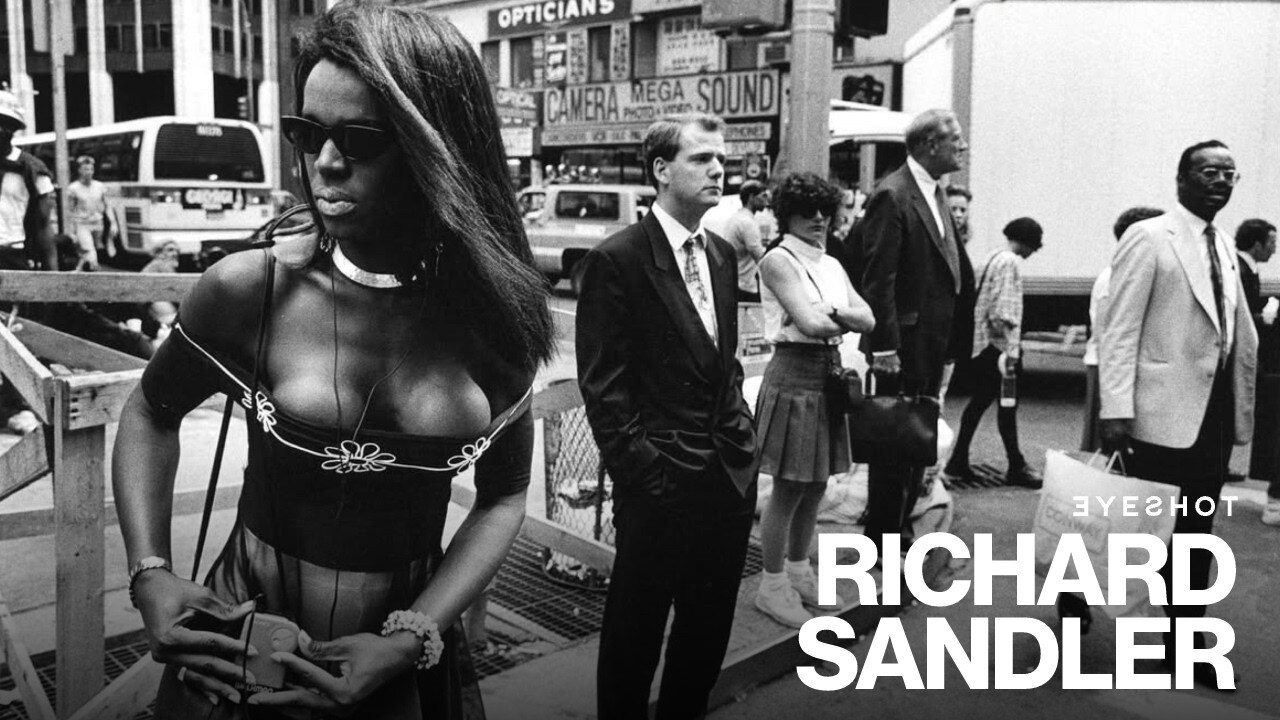
Richard Sandler: Street Photography, Eye Contact & the End of the Old New York | Eyeshot 50mm Ep. 55
Richard Sandler opens Eyeshot Photos’ interview with a position that cuts against one common street-photography ideal: he does not want to disappear. He wants people to register the camera because their unrehearsed response can reveal something human. That claim gives the 58-minute conversation its tension. Presence can produce eye contact and energy; it also creates responsibility.
GOBO reviewed the original Eyeshot 50mm episode, its description, chapters and transcript on 22 November 2026. The page showed 18,641 views, a dated snapshot rather than a measure of artistic authority. Eyeshot Photos created and published the interview on 19 June. Sandler’s official biography identifies him as a street photographer and documentary filmmaker whose work is held in several museum and public collections.
1. Being seen changes the photograph
At the opening, Sandler explains that he values the moment a person notices him and the camera. His interest is not a performed portrait but the face that appears before a practiced expression settles in. It is a useful alternative to the idea that the highest achievement is always to remain invisible.
The lesson is not to provoke strangers for reaction. It is to recognize that the photographer is part of the situation. Distance, body language, eye contact and camera position influence what happens whether the photographer admits it or not. Ethical practice begins by noticing that influence, respecting refusal and understanding local rules and social risk.
Try two approaches in a place where photography is appropriate. Make one frame while observing quietly, then another after a simple acknowledgment. Compare expression, posture and your own distance. The exercise is about presence and consent, not declaring one method more authentic.
2. A layered frame needs more than coincidence
At 18:57, the chapter turns to juxtaposition and complexity. Eyeshot’s description summarizes Sandler’s interest in building two pictures inside one frame. The phrase can tempt photographers to hunt for a clever background sign behind a stranger, but the deeper standard is structural: foreground and background should both contribute to the question the image asks.
Watch the edges before the central subject arrives. Choose a background with separate visual information, then wait for a gesture or face that changes its meaning. Make one clean frame and one deliberately layered frame. If the second picture merely makes identification harder, complexity has become clutter.
Our interpretation is that Sandler’s strongest idea here is not “add more.” It is “make relationships.” A simple photograph can be profound; a crowded frame can be empty. Layering earns its place when the elements create tension, rhythm or ambiguity that one element alone could not supply.
3. Flash and drag are techniques, not a personality
The chapter at 25:20 discusses flash, long shutters and Bruce Gilden. Sandler describes a way of combining a sharp flash contribution with movement across a longer exposure, effectively allowing two kinds of time into one frame. Eyeshot’s description also notes his account of teaching the approach to Gilden and his later decision to stop using flash.
That last decision matters. A recognizable technique can become a trap when the photographer repeats it after the question has changed. Flash close to strangers also has physical and social consequences; surprise is not a substitute for permission or judgment.
Practice the visual principle with a consenting subject. In dim ambient light, use a safe flash position and a slower shutter while the subject or camera moves. Make a second frame at a faster shutter. Compare which parts are fixed by the brief flash and which record ambient movement. Then decide whether the effect says something about the subject or merely announces the technique.
4. A city is not a neutral backdrop
Early in the transcript, Sandler contrasts photographing New York with his current experience in Vancouver. He speaks about privacy, street life, wealth, suffering and his dissatisfaction with his own recent results. These are his observations, not a complete sociological account of either city.
The valuable lesson is his willingness to admit that a successful method in one place may not transfer. Street photography depends on density, pace, public behavior, light, architecture and the photographer’s relationship to the place. A city that offers fewer dramatic collisions is not necessarily visually empty; it may require slower research and different attention.
Before calling a location boring, work one block at the same hour for five days. Record recurring light, movement and interactions without forcing a “New York” template onto it. Write what the place does rather than what it lacks. A change from stills to sound, sequence or film may also be a response to material that cannot fit one frame.
5. Copying the masters is a temporary discipline
Near 50:11, the published chapter is titled “Copying the Masters.” The closing discussion moves toward knowing yourself and knowing your questions. Studying another photographer’s contact, timing or structure can train perception, but imitation becomes useful only when it reveals what you would choose differently.
Pick one photograph you admire and describe it without naming equipment: distance, height, light, relationships, moment and unanswered question. Make a study using the same structural problem, not the same person or location. Then remove one borrowed habit and make the scene yours. Keep both frames and write what changed.
The goal is not a counterfeit style. It is to learn where a method stops fitting your curiosity. Sandler’s own movement between still photography, flash experiments and documentary film supports that reading: a practice can keep its concerns while changing its tools.
What the interview contributes
Eyeshot gives Sandler enough time to contradict simple advice. He values being seen but describes the difficulty of photographing where people value privacy. He developed a forceful flash language and later left it. He respects film but discusses motion pictures and changing technology. Those tensions make the episode more useful than a list of rules.
Our editorial conclusion is that street photography grows when the photographer replaces slogans with questions: What does my presence do? Which relationships make this frame necessary? Is the technique serving the subject? What does this city ask me to change? Which borrowed influence have I understood well enough to leave behind?
The video’s popularity cannot answer those questions, and neither can Sandler answer them for another photographer. The interview succeeds because it makes the questions visible. A productive next step is not to photograph like Richard Sandler. It is to examine your own contact with the street as honestly as he examines his.